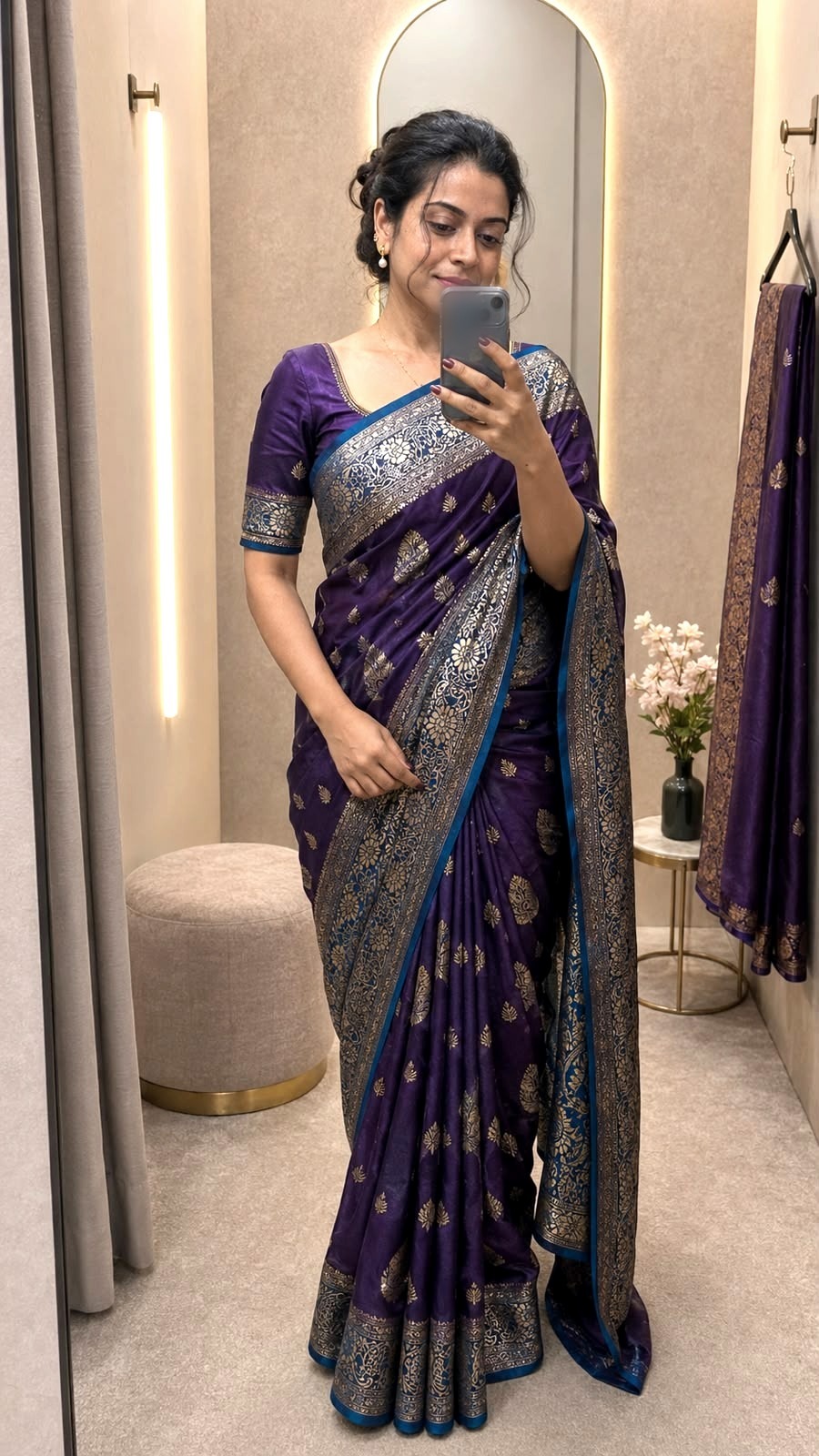
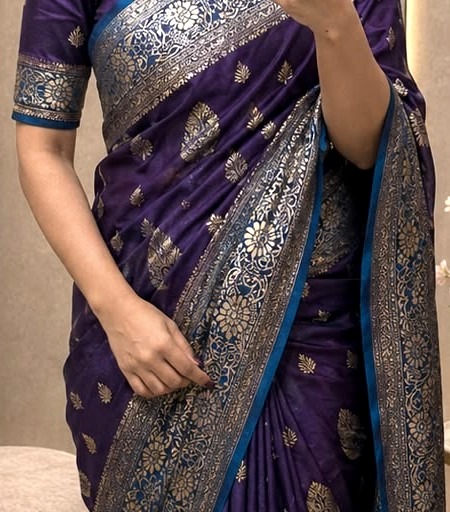
There's a particular weight a good Banarasi has in the hand before it's even draped — a density that tells you immediately this isn't an everyday fabric. The saree in these photographs is a deep aubergine, almost black in low light, scattered edge to edge with small gold zari booti, bordered in a wide brocade panel where the gold work is threaded through with a band of peacock blue — a meenakari accent, the enamelling technique translated into thread. It's a lot of saree. It's meant to be.
Banarasi silk comes from Varanasi, and it carries that city's whole relationship with silk trade, temple ritual and Mughal patronage inside its weave. The brocade technique — zari worked through silk on a handloom, sometimes taking a single weaver anywhere from a week to several months per piece depending on the density of the pattern — dates back centuries, refined under Mughal courts that wanted Persian floral motifs translated into Indian silk. The meenakari border on a saree like this one is a later refinement: coloured silk or enamel-style thread worked into the gold zari so the border catches two colours at once depending on the light, gold most of the time, that flash of blue when it moves.
"A Banarasi doesn't ask to be noticed quietly. It's built for rooms with good lighting and long evenings."
 Rakhi & Co.
This is what makes Banarasi read as premium even before anyone knows the name of the weave: the sheer density of handwork, the jewel-tone palette it's traditionally woven in — deep purples, wine reds, emerald, midnight blue — and a drape with enough weight to hold a pleat and enough sheen to photograph beautifully under both daylight and function lighting. It's a fabric built for the parts of a wedding where you want to be seen from across the room.
What's genuinely interesting is where this weave has travelled. Banarasi is a North Indian textile by birth — Varanasi, Uttar Pradesh, a tradition with no original connection to Andhra Pradesh, Telangana or Karnataka. And yet walk into any bridal boutique in Hyderabad or Bengaluru during wedding season and you'll find rows of it, often styled specifically for South Indian trousseaus. The pattern that's emerged over the last decade or two is fairly consistent: the Kanjeevaram remains the saree for the actual muhurtham, the ceremonial core of a South Indian wedding, non-negotiable and specific to the region's own six-century weaving tradition. But for the reception, the sangeet, the engagement — the events where a bride changes two or three times over a wedding week — Banarasi has become one of the default second and third choices.
Some of that is practical. A Banarasi drapes lighter than a heavy Kanjeevaram, which matters on a second change after a full day in silk. Some of it is simply exposure — pan-Indian wedding culture, mainstream film and a generation of brides shopping across regions rather than only within their own state's weaving tradition, has made Banarasi aspirational far outside UP. And some of it is that the two weaves genuinely don't compete stylistically. A Kanjeevaram's zari tends to sit in bold, contrast-heavy borders on a comparatively simple body; a Banarasi like this one covers the whole body in fine motif work, which reads as a deliberately different register of ornate — not more traditional, not less, just a different vocabulary for the same occasion.
Whatever the reason, the result is a genuinely cross-regional wardrobe now standard in a lot of South Indian trousseaus: a Kanjeevaram for the ceremony that belongs to the region, a Banarasi for the events that belong to the bride. Worth knowing the difference between the two — where each comes from, what each is actually built for — the next time you're the one doing the choosing.
This is the first entry in a new column we're calling Border to Border — one saree tradition at a time, the craft behind it, and where it actually lives today. More to come.