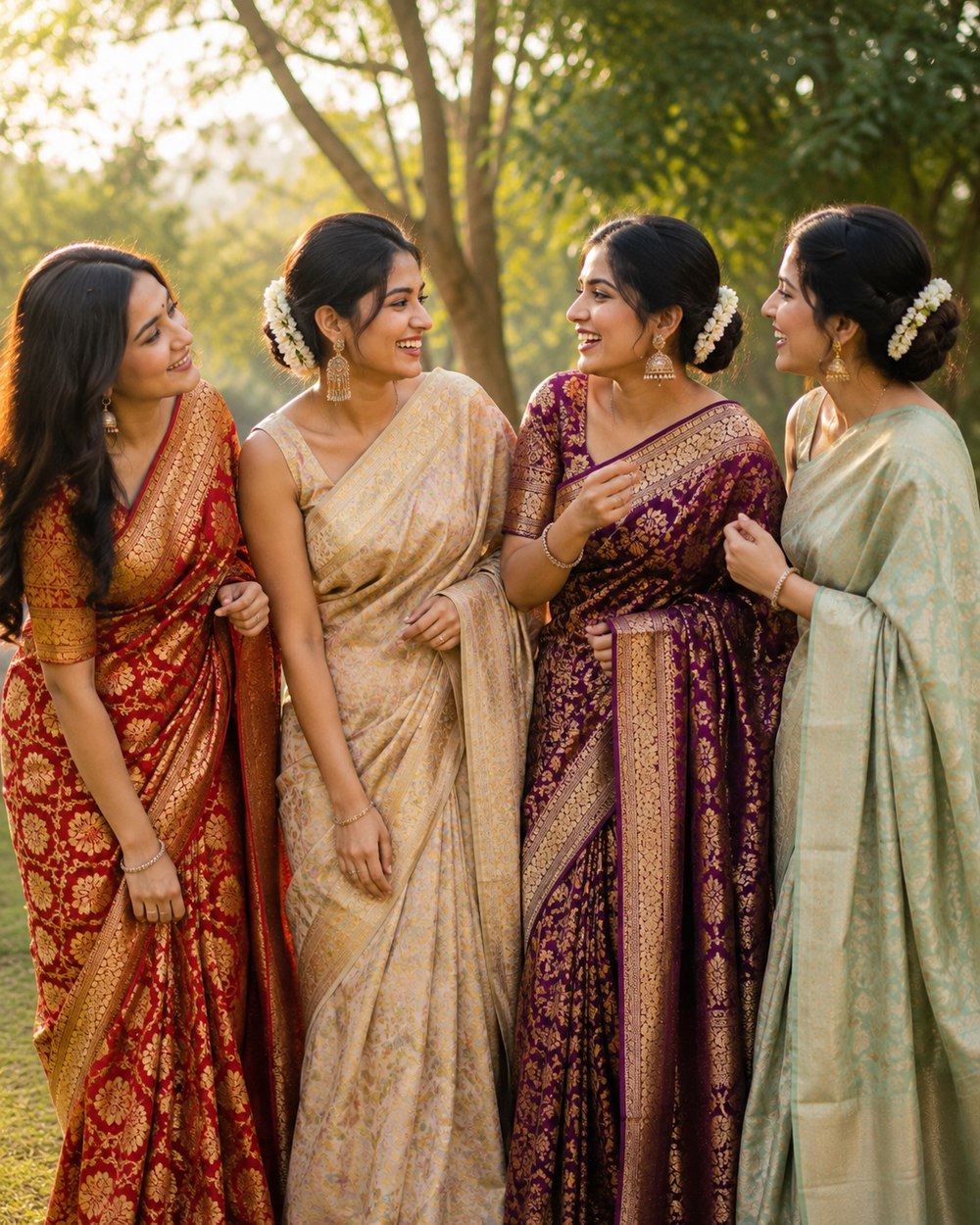
There's a particular week in the calendar when South India seems to change its wardrobe all at once. Varalakshmi Vratham comes first, quiet and interior — a Friday given over to brass lamps, kalasha, and the women of the house dressed the way they'd dress for the goddess herself. Days later, Onam arrives loud and outward-facing, the whole state seemingly out on the street, on the boat, on Instagram. Two festivals, two entirely different moods, and — this is the part I love — two completely different arguments for what a saree is for.
Varalakshmi Vratham dressing is not really about being seen. It's about being appropriate to the moment you're performing. Which is why, year after year, it stays loyal to silk — Kanjeevarams in particular, the kind with a body in one rich tone and a contrast pallu heavy with zari, gold and maroon, gold and green, the classic temple-jewellery palette. Married women lean into the fuller drape, the nose pin, the jasmine in the hair, because the occasion is asking for weight and presence, not novelty. If there's a trend at all in Varalakshmi dressing, it's a quiet one: slightly lighter Kanjeevarams for comfort through a long puja, and a growing number of women reaching for their mother's or grandmother's silk instead of buying new — which, if you think about it, is its own kind of fashion statement.
Onam is the opposite mood entirely, and it starts with one saree that needs no introduction: the Kasavu. Cream or off-white body, that unmistakable gold zari border, worn traditionally as the set-mundu-neriyathu — two pieces, not one, though most of the country just sees "the Kerala saree" and leaves it at that. What's shifted in the last few years isn't the Kasavu itself, which is more or less sacred in its simplicity, but everything happening above the waist. The blouse has become the entire personality of the look — puff sleeves, structured collars, contrast colour blocking in temple-jewellery gold or a single bold jewel tone against all that cream and gold. The saree stays reverent. The blouse gets to have opinions.
 Amal K Raju / Unsplash
"Onam might be the most Instagrammable festival in the country — and Gen Z didn't wait to be invited."
What's genuinely fun to watch is how younger women are treating Onam as a full production. The pookalam — the flower rangoli laid down every morning of the ten-day festival — has become one of the most reliable reel backdrops of the year: a group of friends or cousins in coordinating (never matching, coordinating) Kasavu sarees, kneeling around a flower arrangement they spent an hour building, phone propped against a flowerpot. Thiruvathira, the traditional clapping dance performed in a circle, has had an entirely second life as reel content — the drape holds beautifully in motion, which turns out to matter a lot when the whole point is a slow-motion twirl at the end. Half-up hairstyles instead of the traditional bun, jhumkas doing double duty as both heritage and camera-friendly movement, and a noticeable rise in going sleeveless or cap-sleeve under the Kasavu drape, worn with the kind of ease that says this isn't costume, it's just what we're wearing today.
What ties both festivals together, oddly, isn't the styling — it's the sincerity. Nobody is doing this ironically. A twenty-three-year-old filming a Thiruvathira reel in her grandmother's gold-bordered Kasavu isn't performing tradition for an algorithm; she's just found a format that finally lets tradition look as good on screen as it does in person. That's not a small thing. For years the assumption was that sarees would age out of a generation raised on convenience. What's actually happening is closer to the opposite — the saree turns out to be extremely good at being filmed, and Gen Z noticed first.
Next on the calendar is Durga Puja — a completely different register again: red-and-white tant and Baluchari silk, Kolkata's pandal-hopping culture, an entirely separate set of rules about what gets worn on which day of the pujo. We'll be back with a dedicated piece closer to the season, the way we always meant this column to work — not a trend forecast, just an honest look at what women are actually reaching for, festival by festival.