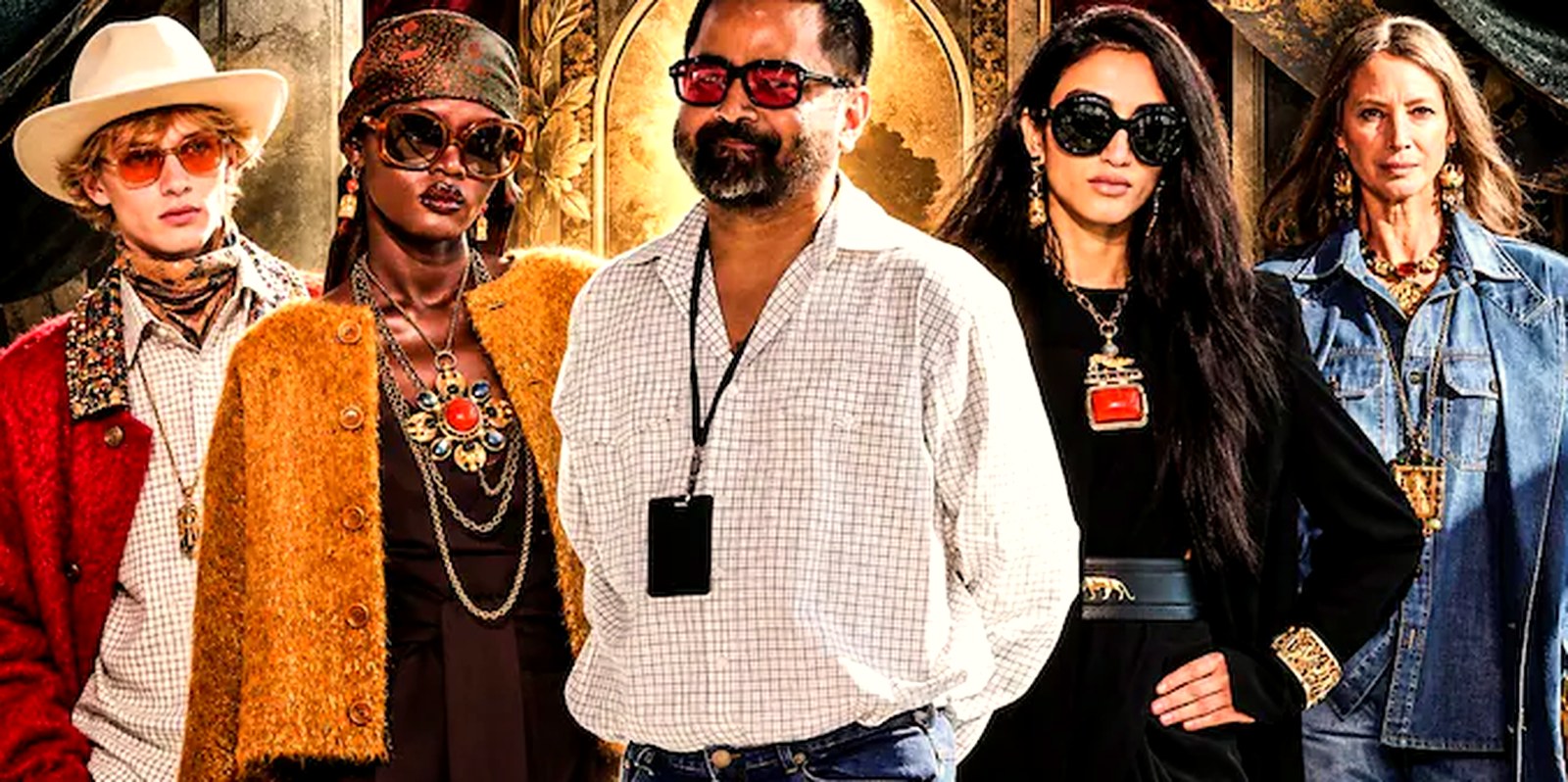
Every fashion week produces a handful of shows that people insist on calling "important," and most of them, honestly, aren't. Sabyasachi Mukherjee's return to New York — his first show there in the better part of two decades — earned the word for a reason that had less to do with the comeback narrative every outlet ran with, and more to do with what he simply refused to do once he got there. He didn't soften anything for the room. He didn't explain what a saree is, or hedge Calcutta's place in a collection built to share a runway with American ready-to-wear. He called it Bengal Byzantine Broadway and treated all three — Bengal, Byzantine history, and the city itself — as equally his to draw from. That's the part we keep coming back to, more than the fact of the return.
The name is doing more work than most collection titles bother to, and it's worth sitting with rather than skimming past. Bengal is where every piece on that runway was actually made — the embroidery, the tailoring, the finishing, all of it out of Calcutta ateliers, unmoved by how many cities the label has opened stores in since. Byzantine points to a high jewellery collaboration debuting the same night with the Metropolitan Museum of Art — his own craft history placed, without asking permission, beside an empire's. And Broadway is the bluntest of the three, but that's rather the point: by the end of a seventy-two-look show, it stopped reading as a wink at the city and started reading as the actual thesis we think this whole collection was built to prove — that an Indian couturier can walk into an American fashion week and simply add his own references to the ones already there, instead of translating himself into somebody else's.
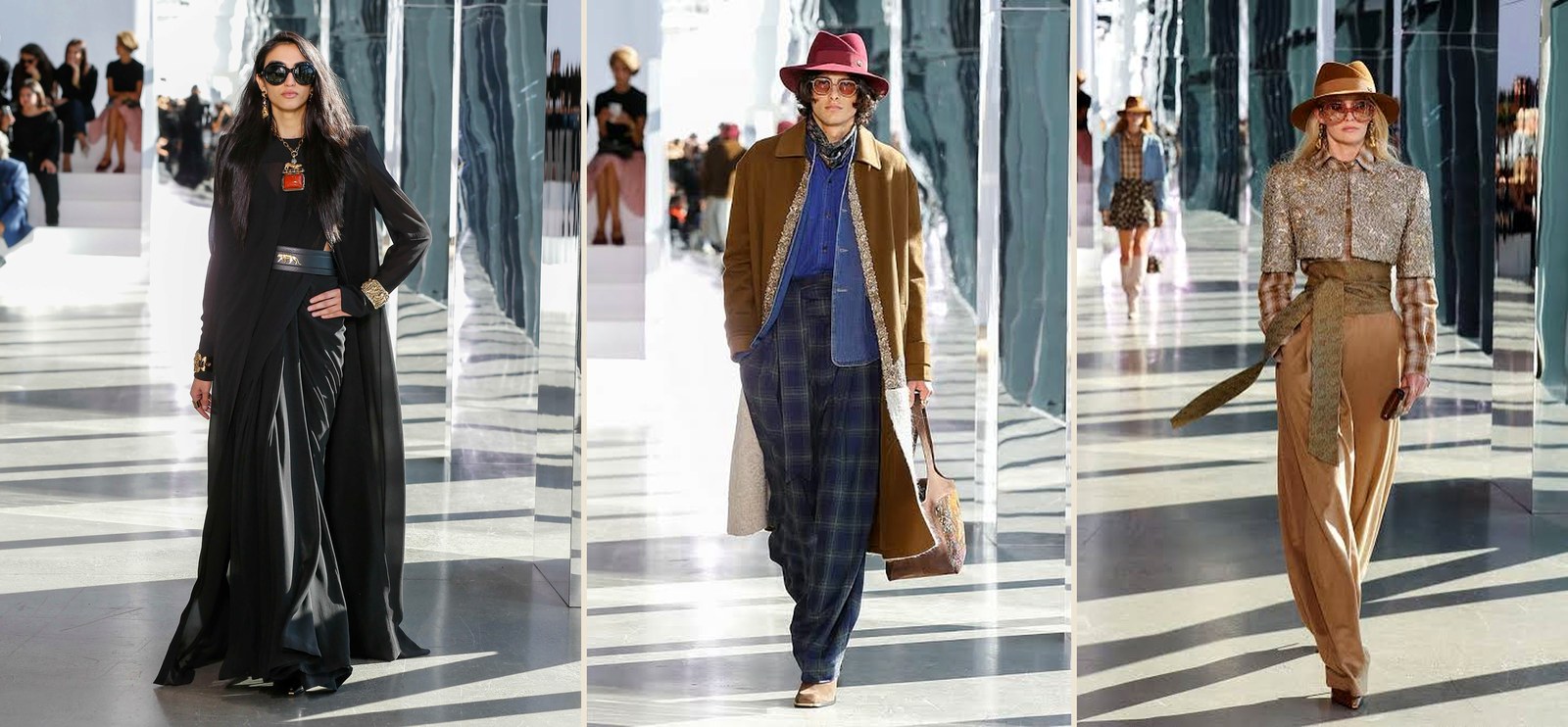
What that looked like, in practice, was less a collision than a very well-dressed negotiation. Cashmere came from Mongolia, denim from Japan, tissue silks from Italy — and every one of those fabrics got run through a distinctly Sabyasachi grammar of cummerbund belts, wrap skirts, neck scarves, and sunglasses several sizes too large to be anything but a statement. A man walked past in a camel coat, pink fedora and green plaid trousers with a denim shirt underneath, carrying a tapestry-woven bag — Americana filtered through a Bengal tailor's eye, or maybe the other way round, it stopped mattering which. Cropped sequin jackets showed up over gingham shirts with fedoras and velvet wrap skirts slit to the knee. Elsewhere, wide-brimmed hats and sashed trousers in warm gold suiting looked like they'd wandered in from a very glamorous ranch. Nothing here read as costume. It read as wardrobe — the kind you'd actually reach for, just assembled from further afield than usual.
 The Web
Three looks from the runway — a jewelled black drape worn like a sari, Americana-by-way-of-Calcutta menswear, and gold suiting with a wide-brimmed hat.
What actually held our attention wasn't the headline fact of a Met collaboration — plenty of designers borrow a museum's name for a season and call it a day. It was how unbothered the pairing felt. This was the first chapter of a multi-year fine jewellery line with The Met, and the pieces weren't shy about naming their sources: a Pantokrator Pendant Necklace drawn from an eleventh- or twelfth-century Byzantine ivory, a Dionysos Cuff lifted from a third-century Roman sculpture, a Zodiac Rivière referencing the zodiac coins minted under the Mughal emperor Jahangir. The clearest example of what this did on a body walked out in an almost severe black look — sheer coat, draped black skirt worn sari-fashion, a leather belt with a gold tiger clasped at the waist, and, at the centre of it all, a single square red pendant with a gold lion crest doing more work than the rest of the outfit combined. It's a specific kind of confidence, reaching into three unrelated empires' worth of history and deciding all of it is fair material for an Indian designer's runway, no explanatory footnote required. He said as much himself, better than we could.
"Indian craftsmanship does not have to be presented as ethnicity. It can be part of a modern international wardrobe."Sabyasachi Mukherjee
Christy Turlington opening the show in a denim-on-denim look felt like the thesis stated before a single embroidered stitch appeared — the most ordinary American fabric there is, sitting next to Calcutta needlework and Byzantine gold, neither one apologising for the other. Seventy-two looks later, a front row that included Anaita Shroff Adjani, Prabal Gurung and Olivia Palermo was still watching closely, which is usually a decent sign the argument landed.
But the image that actually stayed with us afterward wasn't from the runway at all.
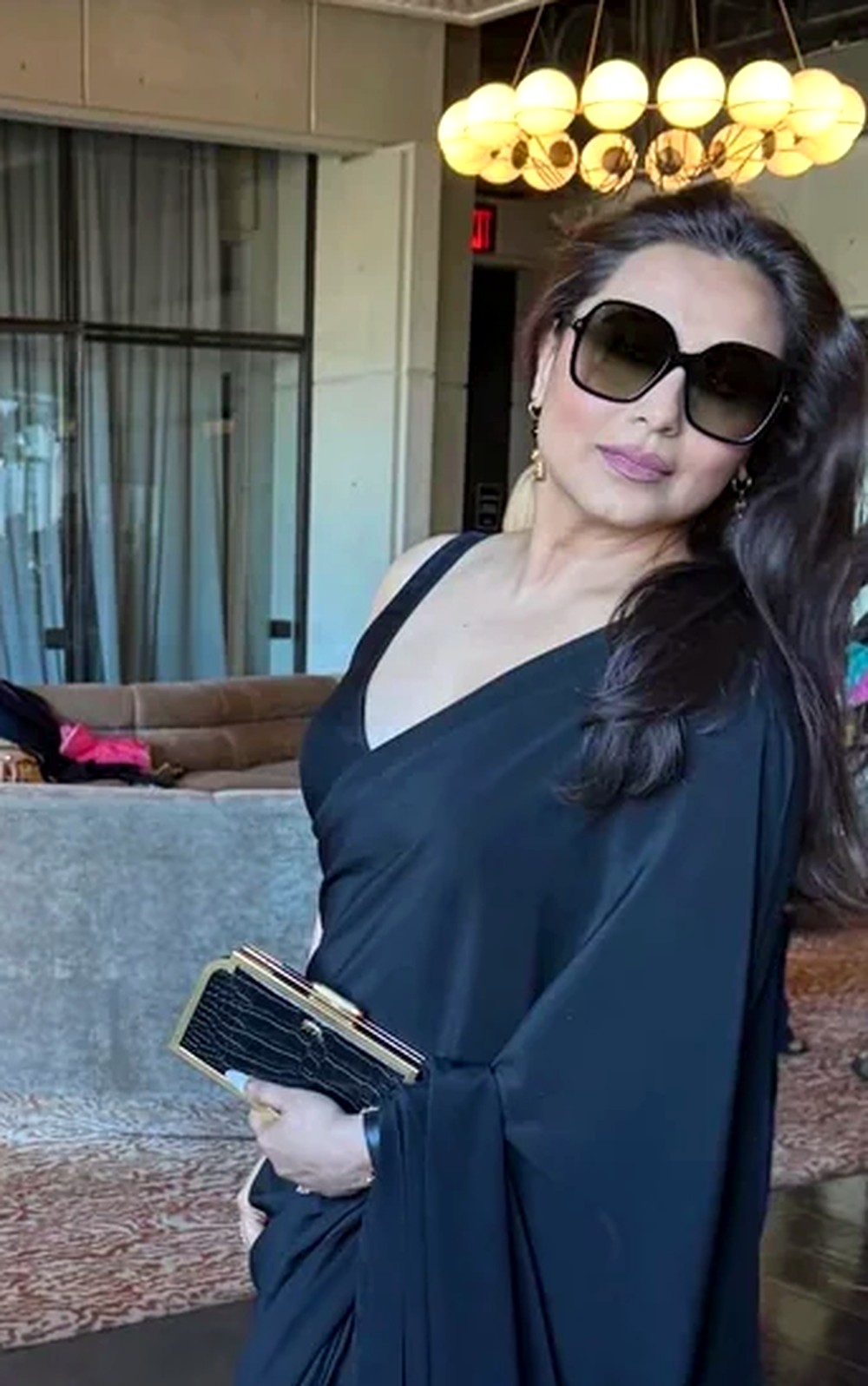
It was Rani Mukerji, outside the venue, in a plain black silk saree with a sleeveless blouse cut into a deep V — no embroidery, no zari, no borrowed empire's jewellery vault, nothing asking for attention beyond oversized black sunglasses, delicate gold earrings, and hair left down over one shoulder the way it falls when you've stopped thinking about it. Next to seventy-two looks built from Mongolian cashmere, Roman sculpture and Mughal coinage, hers was — if anything — the more radical outfit in the building. It didn't need a single word of explanation for why it belonged in that room.
 The Web
Rani Mukerji at the show — black silk, no embellishment, and the kind of ease that comes from three decades of getting dressed in front of a camera.
That's the thing about watching someone like Rani Mukerji get dressed for an evening like this one — she isn't trying to win the room, and that's exactly why she does. A saree with no ornamentation at all is, in its own way, a harder thing to wear well than one covered in embroidery; there's nowhere for the drape to hide if it isn't sitting right, no zari to distract from a blouse that doesn't fit. She's been doing this long enough that none of it looks like effort — the pallu falls where it should, the sunglasses do the work a statement necklace usually would, and the whole thing reads less like a red-carpet look and more like a woman who simply knows, after decades of practice, exactly how much a good drape can carry on its own.
Which is really the whole point we wanted to make here, more than a runway recap. Sabyasachi spent a show, a Met collaboration and three continents' worth of craft arguing that Indian luxury doesn't need translating for a global audience. Rani Mukerji made the identical argument in one saree, standing outside a venue with a clutch in hand, no runway required. We happen to agree with both of them — it's more or less the whole reason this Journal exists.